


General
Who develops InfiniDesk?
InfiniDesk is developed by Ben Shirt-Ediss, a registered Apple Developer. The InfiniDesk app is code-signed by the developer and notarized by Apple as being trustworthy.
In this blog post, you can read about how InfiniDesk had humble beginnings back in 2018 as a simple Terminal app.
Is InfiniDesk another "window manager" for Mac?
No, InfiniDesk is not another window manager app!
InfiniDesk is actually not concerned with windows at all. Rather, it's a desktop contents manager.
It gives you multiple virtual desktops on Mac, each with its own layout of files, folders, widgets and wallpaper. You can easily switch between Desktop Views from the Mac menu bar to focus on a project, or move to a clean desktop for presentations and video calls without distractions.
InfiniDesk is loosely inspired by the Common Desktop Environment interface that existed on Unix workstations in the 1990s. Here, users could select between four completely independent Desktops (each with independent desktop icons, windows and colour scheme).

How does InfiniDesk handle data safety and user privacy?
✔ Your Mac data is safe with InfiniDesk. The app only changes the visibility of files and folders in the Mac's Desktop folder, based on the current Desktop View. By design, the app never deletes, moves, renames, or copies any of your files or folders. Since your data is never modified or relocated, data loss is impossible with InfiniDesk.
✔ InfiniDesk is 100% private. The app does not connect to the internet to transfer data externally. Period. By design, InfiniDesk runs fully locally on your Mac. We are committed to user privacy - see our Privacy Policy.
How was AI used when creating the app?
InfiniDesk is not a "vibe coded" app. It is written by an experienced software developer.
80% of the app's code was written manually in Sublime Text editor (human hands on keyboard). Around 20% did originate from prompting AI (like Stack Overflow would have been used in the old days). However, AI code was always manually reviewed, refactored into the developer style and thoroughly unit tested before incorporation into the app's code base. AI never worked directly on the app's code base.
All of the high level state logic of the app was manually written and tested to ensure proper treatment of edge cases. Initial development time was 6 months because of this.
The original code base was written in 2018 (a time when no AI yet existed) when InfiniDesk began as a Terminal app called Clarity.
What is the version history of InfiniDesk?
Version 3.22 was released on 10 September 2026. This fixed a bug with Follow Spaces mode, so it now properly persists across macOS reboots. Also, widget toggle on/off was fixed when Stage Manager is enabled.
Version 3.21 was released on 24 August 2026. This fixed a bug with hotkeys firing double events when the menu was open.
Version 3.2 was released on 21 August 2026. This made Follow Spaces Mode more robust, allowing it to work with the new macOS 27, and also all previous editions of macOS back to macOS 11!
Version 3.1 was released on 17 August 2026. It featured:
- Automation: another Mac app (Raycast, Alfred, Apple Shortcuts, Terminal, etc.) can now tell InfiniDesk to switch to a different Desktop View.
- Menu indicators to show which Desktop Views have a wallpaper set and/or widgets visible.
- InfiniDesk spirolateral logo at the top of the menu, and an improved Getting Started menu.
- Minor bug fixes for HUD display notifications and for Disabled Mode when switching back to a Desktop View.
Version 3.01 was released on 5 May 2026. This fixed a bug in how hotkeys work with renamed Desktop Views.
Version 3.0 was released on 30 April 2026. It featured:
- Global keyboard hotkeys to quickly switch the Desktop View.
- Support for copying items between Desktop Views (so the same item can appear on multiple Desktop Views)
- Fading onscreen display notifications to make it clear which Desktop View has been switched to.
- Shorter and more streamlined menu.
- Steamlined Getting Started sequence (where user is no longer required to manually select the Desktop folder).
- Many technical improvements: More robust interaction with Mac's Transparency, Consent, and Control (TCC) for user permission setting; implementation of thread locking; security improvements.
Version 2.31 was released on 27 January 2026. This is a minor stability update.
Version 2.3 was released on 19 January 2026. It featured:
- The option to hide desktop widgets on a Desktop View.
- An easier way to change the icon for a Desktop View using the Mac Emoji & Symbols viewer.
- Support for copy and paste into the application dialog boxes.
- Recovery Mode: disable the app even when its not visible in the Mac menu bar.
- Localisation to 🇪🇸 Spanish, 🇷🇴 Romanian and 🇯🇵 Japanese.
Version 2.2 was released on 6 December 2025. It added these features:
- The ability to make InfiniDesk an icon in the menu bar.
- In-app diagnostics.
- Stability improvements.
Version 2.01 was released on 23 October 2025. This fixed a bug when quitting the app from Follow Spaces mode.
Version 2.0 was released on 13 October 2025. It added these features:
- Two operation modes - Classic Mode and Follow Spaces Mode. Two different ways to organize your Mac desktop.
- The ability to select a wallpaper for each Desktop View.
- Localisation to 🇩🇪 German and 🇫🇷 French.
- The ability to check for updates in-app.
- Stability improvements.
Version 1.0 was on released 12 June 2025. This was the first minimum viable product, able to switch the desktop icons.
All versions are compatible with macOS 11, 12, 13, 14, 15, 26 (Tahoe) and 27 (Golden Gate).
What updates are planned for the future?
Future updates (tentative) include an official way to backup InfiniDesk and Desktop Views with periodically updating wallpapers (information dashboards).
Why is InfiniDesk not on the Mac App Store?
InfiniDesk is only available from the infinidesk.app website and via Homebrew.
It is sold outside the Mac App Store for two reasons:
- The App Store does not support one-time payment apps that offer a full free trial. To us, it is important that users try the app before they buy to see if it improves their focus and productivity on Mac.
- InfiniDesk needs access to the Desktop folder and Finder to work correctly, which are operations typically restricted by the Mac App Store's sandboxing rules.
It's quite common for independent Mac apps to be distributed outside the App Store, especially when they require more control over licensing, updates, or system integration. InfiniDesk is still safe: it is code-signed by the developer and notarized by Apple.
Trouble Shooting
🚨 I cannot install the app
Try these full installation instructions:
- Download the app and double click the InfiniDesk.dmg installer file.
- In the installer window, move the InfiniDesk icon across and drop it over the Applications folder icon. The app is now installed on your Mac.
- Note: The app is distributed outside the Mac App Store. Therefore, in System Settings › Privacy & Security › Security you may need to allow your Mac to run apps from "App Store & Known Developers".
- In System Settings › Desktop & Dock , in the Desktop & Stage Manager section, make sure that Show Items "On Desktop" and Show Items "In Stage Manager" are checked. In the Widgets section, also make sure that Show Widgets "On Desktop" and Show Widgets "In Stage Manager" are checked.
- Launch the app. On first launch, a message similar to below will be shown. This is a normal message for Mac apps distributed outside the Mac App Store. Click Open. InfiniDesk will load in the Mac menu bar, at the top right of the screen.
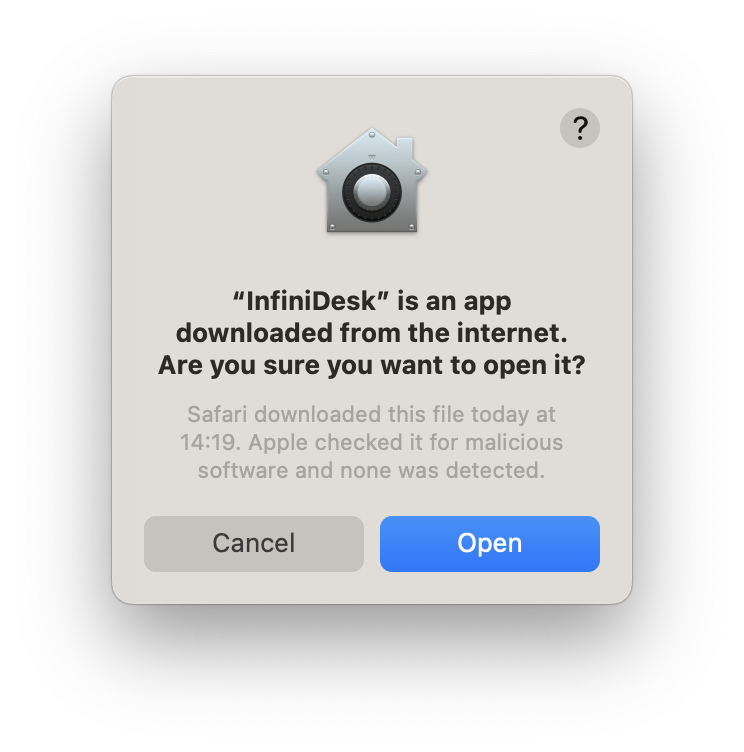
Note that InfiniDesk does not have an icon that appears in the Dock.
🚨 InfiniDesk does not appear in the Mac menu bar when I start the app
If you launch InfiniDesk and you don't see it in the Mac menu bar (at the top right of your screen), this could be for a number of reasons. First, confirm that the app is running by opening the Activity Monitor app.
Reason 1
If you are using a menu bar manager app (like Ice menu bar manager) to keep menu bar icons organised, make sure in the menu bar manager settings that InfiniDesk is set to be visible and not hidden.
If on macOS 26 Tahoe or later, also check in System Settings › Menu Bar that InfiniDesk appears as enabled in the "Allow in the Menu Bar" section.
Reason 2
It could be that there is not enough physical space in the Mac menu bar to display InfiniDesk.
This is a menu bar that is just about big enough to fit InfiniDesk:

But opening another menu bar app, like keyboard language, makes InfiniDesk disappear behind the notch (red arrow below). It is still running, but it is not visible:

This is a classic problem on macOS. To make InfiniDesk reappear, try closing/hiding some of the other menu bar apps.
Reason 3
If you are running macOS 26 Tahoe, early versions of Tahoe (26.0 and 26.1) can have issues displaying menu bar icons properly. If on Tahoe, ensure you are using the latest version.
If the problem persists, please Contact Us.
🚨 InfiniDesk starts, but switching Desktop View does not change the desktop contents
This could be due to several reasons:
- Check that you are not displaying hidden files on your Mac. Use the keyboard shortcut Command (⌘) + Shift (⇧) + Period (.) to toggle hidden files on and off. Toggle them to off.
- On more recent macOS, check in System Settings › Desktop & Dock › Desktop & Stage Manager that Show Items "On Desktop" is checked.
Permissions
What permissions must I grant InfiniDesk, and why is each permission needed?
InfiniDesk needs a few system permissions to work correctly with your Mac. Each permission serves a specific purpose and is only used to support the app's core functionality.
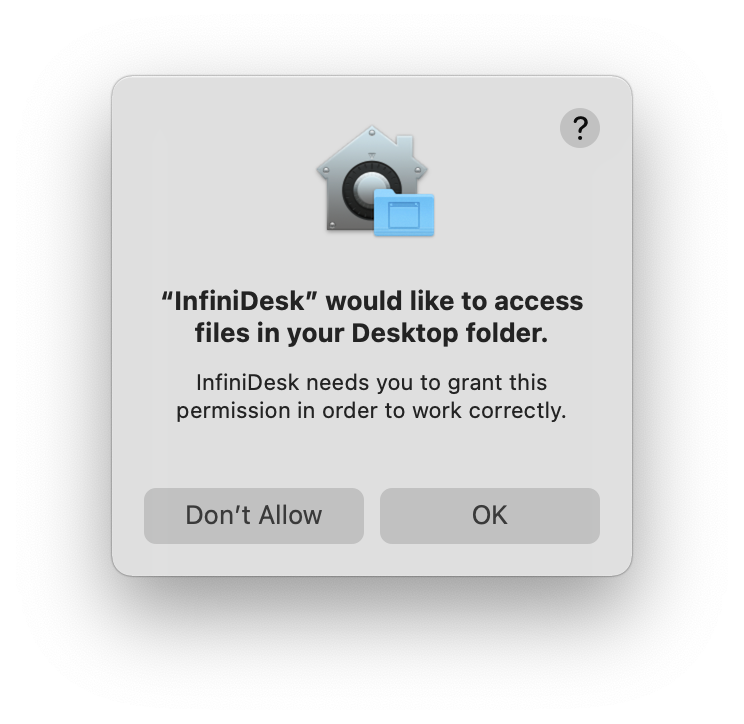
"InfiniDesk" would like to access files in your Desktop folder. This permission allows InfiniDesk to manage the visibility of files and folders in your Desktop folder. This is essential to allow the app to organize and declutter your Mac desktop.
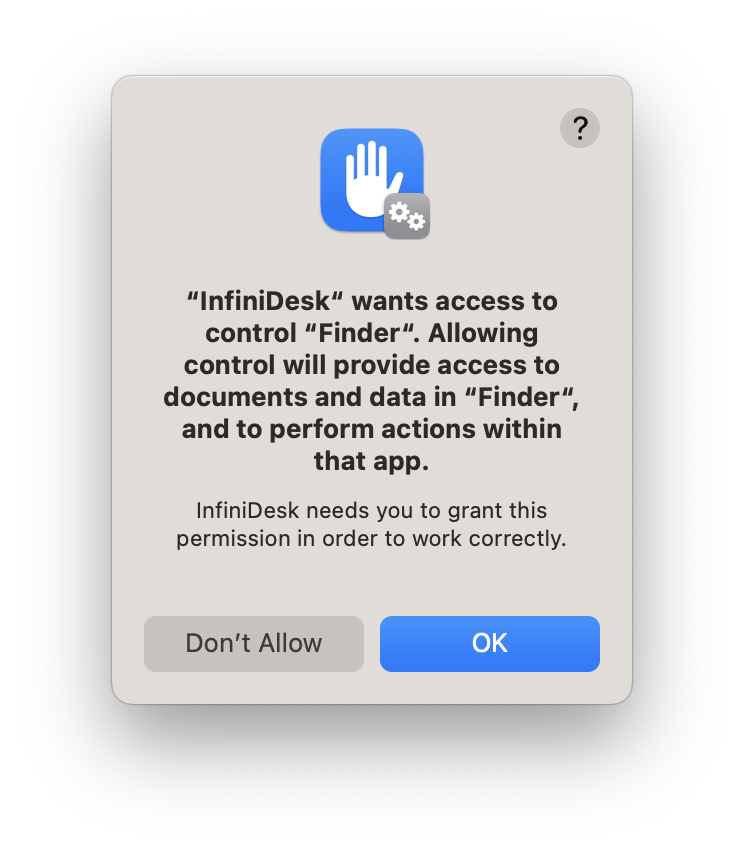
"InfiniDesk" wants access to control "Finder". This lets InfiniDesk detect which items you've selected on the desktop, so it can move or copy them to another Desktop View when you use the Move/Copy Selected Desktop Items to... feature. This is the app's only interaction with Finder.
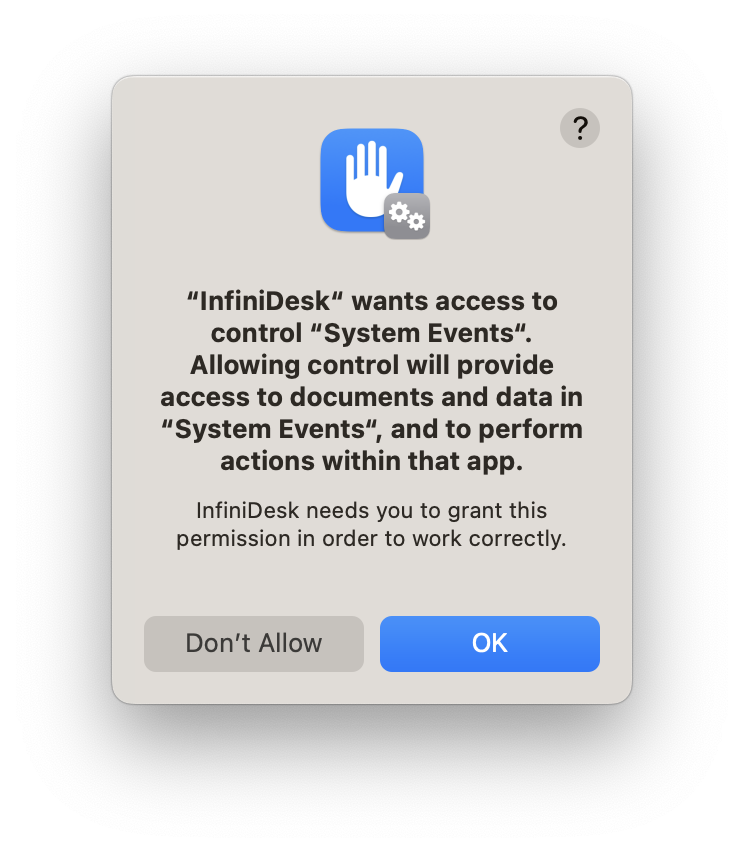
"InfiniDesk" wants access to control "System Events". This enables InfiniDesk to add itself to your Mac's startup items, if you've chosen to have it launch automatically when your Mac starts.
Remember: InfiniDesk never sends any data externally and does not use these permissions for anything unrelated to its Mac desktop management features.
Using InfiniDesk
Can I turn off the annoying system beep when hotkeys are pressed?
Yes. Go to System Settings › Sound and drag the Alert Volume slider down to 0.
Does the app work with multiple monitors?
It depends on the mode: InfiniDesk has two modes, Classic Mode (where you select the Desktop View from the menu bar and this displays in all Spaces) and Follow Spaces Mode (where the desktop contents change depending on the Space selected).
✅ Classic Mode works with all single and multi-monitor setups. This mode does not care which Spaces are currently showing on each of your monitors, and icons will be correctly positioned across your monitors when you select a Desktop View.
✅ Follow Spaces Mode works when:
- You have a single monitor
- You have multiple monitors that share the same set of Spaces.
❌ Follow Spaces Mode does not support multiple monitors if each monitor has a different set of Spaces. In this case, the app is designed to default back to Classic Mode.
Can I still use normal ways of organising desktop icons (Stacks, Sort By etc.)?
Yes. InfiniDesk is fully compatible with existing Mac desktop management features like Stacks, Sort By, Clean Up, and other options available by right-clicking the desktop.
- If Use Stacks is enabled, each Desktop View shows its items grouped into stacks.
- Sort By options apply to all Desktop Views. Sort By None preserves manual arrangement.
- Clean Up can be used to reorganize icons on individual Desktop Views.
- Icon size, grid spacing, and text size on the desktop can also be adjusted as usual (and applies across all Desktop Views).
How do I update the app?
Simply download the latest app version from the InfiniDesk website and drag it into your Applications folder, replacing the old app version.
If you're already registered, the new version will be automatically registered too.
Can I install, update and uninstall the app using Homebrew?
Yes. The app is available on Homebrew.
brew install --cask infinidesk (Install)
brew upgrade --cask infinidesk (Update the app)
brew uninstall --zap infinidesk (Completely uninstall the app)
What if I get a new Mac? or change my email address?
If you have registered InfiniDesk and then want to move your existing registration to a new Mac, or if you want to change your registered email address, please Contact Us. The transfer is free of charge and we will be happy to help you.
How can I completely uninstall the app?
- In the InfiniDesk menu, select General Settings › Disable InfiniDesk. This will make all Desktop Views visible at once. All the folders and files managed by InfiniDesk will now be visible in your Desktop folder.
- Quit the InfiniDesk application.
- Drag InfiniDesk.app from your Applications folder to the Trash/Bin.
- Delete the folder at ~/Library/Application Support/InfiniDesk to remove InfiniDesk's settings.
Or, if you installed via Homebrew use brew uninstall --zap infinidesk.
Using iCloud and Other Backup Services
Can I turn on iCloud Desktop and Documents sync when using InfiniDesk?
It's NOT recommended to use iCloud Desktop and Documents sync when using InfiniDesk.
The app will give a warning if it detects iCloud sync of the desktop is on.
It's not recommended because iCloud changes file attributes by itself, and sometimes moves files to the cloud only, leaving only file "stubs". These iCloud actions interfere with InfiniDesk and can lead to the app not working properly.
Can I backup my desktop with another cloud service? (Google Drive, Dropbox etc.)
Yes, when using InfiniDesk you should still be able backup your Mac desktop to another cloud service.
For example, in Dropbox you can select to back up the Mac desktop and this does not affect the operation of InfiniDesk.
In the webpage of the cloud service, you should be able to see all of the files and folders on your desktop, even the currently hidden items.
⚠️ While using InfiniDesk, we recommend to use a cloud service for backup only, not for directly restoring files back to the desktop. If you do want to restore files, select General Settings › Disable InfiniDesk in the InfiniDesk menu first.
If I use a manual backup system like Time Machine, will it back up all my desktop contents?
Time Machine works with InfiniDesk. It backs up the items visible in the current Desktop View, and also all of the hidden files present on the other Desktop Views.
Other manual backup applications will also work if they preserve the standard BSD file flags (like e.g. Carbon Copy Cloner does).
Tips:
- Within Time Machine (or another backup app), you can verify yourself that all files on your desktop are backed up (including the ones on hidden Desktop Views) by toggling hidden files on Command (⌘) + Shift (⇧) + Period (.).
- Or, you can select General Settings › Disable InfiniDesk in the InfiniDesk menu (which makes all items visible on your desktop) and then run a backup.
- Also make sure to back up the ~/Library/Application Support/InfiniDesk folder, to save the state of the InfiniDesk menu.
⚠️ While using InfiniDesk, we recommend to use a manual service for backup only, not for directly restoring files back to the desktop. If you do want to restore files, select General Settings › Disable InfiniDesk in the InfiniDesk menu first.
Minor Issues
InfiniDesk multi-desktop integration with macOS generally works well and most users will experience no problems. However, there are some minor outstanding issues which are listed below along with work-arounds.
Minor Issue 1: iCloud Desktop and Documents syncing must be disabled
Issue: iCloud Desktop and Documents syncing interferes with InfiniDesk's management of desktop files/folders.
What to do: Turn off iCloud Desktop and Documents syncing.
Minor Issue 2: Switching between Desktop Views occasionally appears non-instantaneous or patchy
Issue: Switching between Desktop Views may not always appear instantaneous. Occasionally, you might notice a brief delay or a "patchy" transition where some files take a moment to hide or appear.
What to do: Wait - it's just a short cosmetic delay caused by the way Finder updates the Desktop display after file attributes change.
Minor Issue 3: "The item can't be replaced because it's invisible" warning
Issue: This message means that you are trying to copy a file to the desktop, but the file actually already exists there in an invisible state.
For example, this message appears when you copy a file from 'Desktop 1' to the Documents folder. Later, you switch to 'Desktop 2' and try to copy that same file from Documents to 'Desktop 2'. Then macOS warns you that the file can't be replaced because it's already on the desktop, but invisible (i.e. it's on 'Desktop 1' which is currently hidden).
What to do: Simply click "OK" to cancel the operation. The warning just means the file is already present on a different, currently hidden, Desktop View.
Tip: Use Move/Copy Selected Desktop Items to... in the InfiniDesk menu instead, to safely move items between Desktop Views.
Minor Issue 4: InfiniDesk cannot manage some types of desktop item
InfiniDesk cannot toggle the visibility of the following types of desktop items:
- Full application packages, like those in the Applications directory. However, these are unlikely to be on the Desktop. Aliases to applications are handled with no problems, though.
- Linux-style hard links created using Terminal command ln. However, these types of link are rare.
- Mounted drives.